QI Family of Measures Planner · Free
Plan a family of measures that is ready for your QI mentor's review.
Write each outcome, process and balancing measure as a full operational definition. A plan check shows what is missing, from a denominator to a balancing measure to enough data points for a run chart. Record the sign-off, see every later change, and download a data collection sheet. No account, no upload.
For residents, nurses, QI coaches and quality teams. Measure definitions only, never patients.
Why QI measurement plans come back with red ink
Most quality improvement projects start with a worksheet: list your outcome, process and balancing measures, define each one and explain how the data will be collected. Mentors and QI committees then see the same gaps: a percentage with no denominator, unwritten exclusions, no balancing measure, or monthly data over a six-month project, which leaves six points and no usable run chart.
This planner turns the worksheet into a guided form with a plan check that catches those gaps as you write. Record the sign-off when the plan is approved, and every later change is listed for you.
How the family of measures planner works
1. State the aim
Write the aim with a number and a date, and set the data collection dates.
2. Define each measure
Numerator, denominator, exclusions, data source, owner, frequency, sampling, baseline and goal.
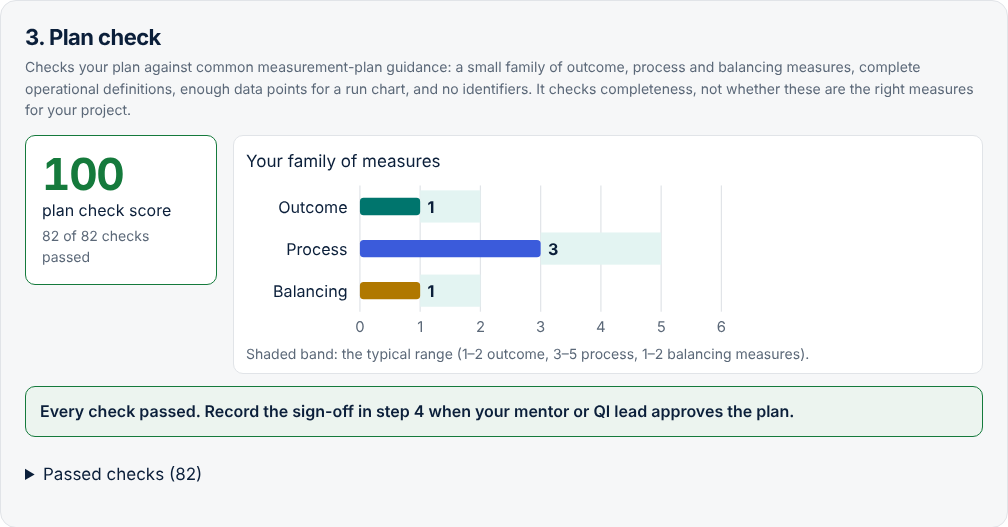
3. Run the plan check
A score, a chart of your family against the typical range, and what to fix.
4. Sign off and collect
Record the sign-off, track changes, print the plan and download data sheets.
Outcome, process and balancing measures
The planner follows the measurement approach of the Model for Improvement as described by the Institute for Healthcare Improvement (IHI: Establishing Measures):
- Outcome measures show how the system is working for patients or customers, such as a clinic no-show rate.
- Process measures show whether the parts you changed are performing as planned, such as reminder calls made.
- Balancing measures check that improving one part is not causing new problems elsewhere, such as front desk time.
IHI suggests a modest set of about four to ten measures. The IHI QI project measures worksheet and the Safer Care Victoria template give the typical mix: one or two outcome, three to five process and sometimes one or two balancing measures. The plan check treats these ranges as guidance, not rules.
What the plan check looks for
- Complete operational definitions: numerator and denominator, unit, data source, who collects, frequency and sampling.
- A balanced family: outcome, process and balancing measures, and not more than anyone will collect.
- An aim with a number and a date, and a baseline and goal pointing in the improving direction.
- Enough data points: a run chart works best with at least 10 (Safer Care Victoria: run charts).
- No duplicates and no identifiers, such as record numbers, dates of birth or phone numbers.
Then download a data collection sheet for each measure and chart your weekly results in the QI Run Chart Builder. Two fictional example projects are built in.
Who it is for
- Residents and fellows leading the QI project their program requires (AAFP: QI and patient safety in residency).
- Nurses and nurse leaders running unit-based improvement projects.
- QI coaches and faculty mentors who want plans complete before the first meeting.
- Medical, nursing, PA and pharmacy students learning the Model for Improvement.
Pricing
The free planner is complete and live now.
Free
- Up to 20 projects and 15 measures each
- Full operational definitions and the plan check
- Sign-off and changes since sign-off
- Printable plan, CSV plan, data collection sheets and JSON backup
Pro
or $5 a month, for one person; a year covers a typical QI project
- Word and PDF export of the plan with a sign-off page
- Project charter: SMART aim, scope, team roles and a driver diagram
- Send a data collection sheet straight to the QI Run Chart Builder
- Data collection reminders as calendar (.ics) events
Team
for a residency program or QI office: up to 25 people; annual invoicing available
- Everything in Pro for each person
- Mentor review: comments and sign-off on shared plans
- Program view of every project's plan check and sign-off status
- Program templates with required measures and fields
Pro and Team are in early access. Reserving a spot is free and nobody is charged until their plan is activated. The prices shown are the planned launch prices, and we will email you from admin@med-rise.com before anything is billed.
Family of measures FAQ
What is a family of measures in quality improvement?
A small set of measures that together show whether a change is an improvement: outcome measures for the result, process measures for whether the changed steps are happening, and balancing measures for new problems the change might cause. Improvement guides commonly suggest one or two outcome measures, three to five process measures and one or two balancing measures.
What is an operational definition?
A description of a measure clear enough that two people collecting it would get the same number: what is counted, the numerator and denominator for a percentage or rate, what is included and excluded, where the data come from, who collects them, how often and whether you sample.
How many data points do I need?
A run chart works best with at least 10 data points. The plan check counts the complete data collection periods between your start and end dates for each measure and warns you when a measure will have fewer than 10.
Can I enter patient data?
No. A measurement plan describes how you will count, not who the patients are. Never enter names, record numbers, dates of birth or other identifiers. The plan check looks for common identifier words and patterns and asks you to remove them, and the data collection sheet records totals per period only.
Does the plan check tell me if I chose the right measures?
No. It checks that the plan is complete and consistent: a balanced family, full operational definitions, a baseline and goal in the right direction, enough data points and no identifiers. Whether these are the right measures for your project is for your team, your mentor and your QI office to decide.
Where is my data stored?
Only in your browser's local storage on the device you use. Nothing is sent to MedRise. Back up saves a file you can restore on another device, and Clear my data deletes everything.
Get your measurement plan right before the first PDSA cycle
Free, private and ready in your browser.
Education and workflow support only. QI Family of Measures Planner helps you write down and check a measurement plan. It does not choose measures for you, does not decide whether a project is quality improvement or research (ask your organization's IRB or QI office), does not analyze patient data and does not replace your organization's QI process or professional judgment. It is not for patient information. See the terms and disclaimer and privacy notice.