Practice Competitor Analysis · Free
Medical practice competitor analysis, done in an afternoon.
Score your practice and the clinics, urgent cares and telehealth services around you on what patients actually compare. See where you lead, where you lag and where nobody is strong, then print a one-page competitive brief. No account, no upload.
For practice owners, practice managers and marketing leads. Practices only, never patients.
Your competition is no longer just the practice down the street
A patient today can choose an independent practice, a hospital-owned clinic, an urgent care, a retail clinic or a telehealth visit. Few practices have written down how they actually compare, so marketing money goes to messages every competitor already uses.
The AMA's guide to finding your practice's marketing advantage asks you to identify your main competitors, ask how their offerings differ from yours and look at what they advertise and say (AMA). Physicians Practice suggests a competition grid: competitors down the side, the features patients compare across the top (Physicians Practice, 2018). This tool turns that grid into scores, a map and next actions.
How the competitor analysis works
1. Describe your market
Your area, specialty, the patients you want and one fact you can prove.
2. Add competitors
Up to nine, of any type, with each one's main message, claimed difference and your sources.
3. Pick the factors
Fourteen ready-made factors in six groups, each weighted, plus your own.
4. Score and read the results
Overall standing, a positioning map, gaps, open lanes, actions and a printable brief.
What a healthcare competitive analysis should compare
The built-in factors cover what a new patient weighs before booking. Turn off any that do not apply and add your own.
- Access: new-patient wait, evening and weekend hours, same-day or walk-in visits, telehealth.
- Services: range of services and a signature or specialty service.
- Coverage and price: insurance plans accepted and self-pay price transparency.
- Reputation: online star rating and number of reviews.
- Digital: website and online booking, search and maps visibility.
- Experience: languages spoken, location, parking and transit.
Every factor is scored from 1 (poor) to 5 (best in the area). Unknown scores are left out rather than counted as zero, and an advantage stays provisional until every direct competitor is scored on it.
Reading the results
- Your advantage: you are strong (4 or 5) and ahead of every direct competitor. Lead with it, and show the proof.
- Open lane you lead: no direct competitor is better than below average and you are strong. Usually your best message.
- Open lane: no direct competitor is strong, and neither are you. Worth investing in if your patients value it.
- Gap to close: a direct competitor is at least two points ahead. Fix it or stop competing on it.
- Direct or not: an urgent care or telehealth service may beat you on access alone. Untick "Count in gaps" for it and it stays on the map and in the standing table without driving your gaps.
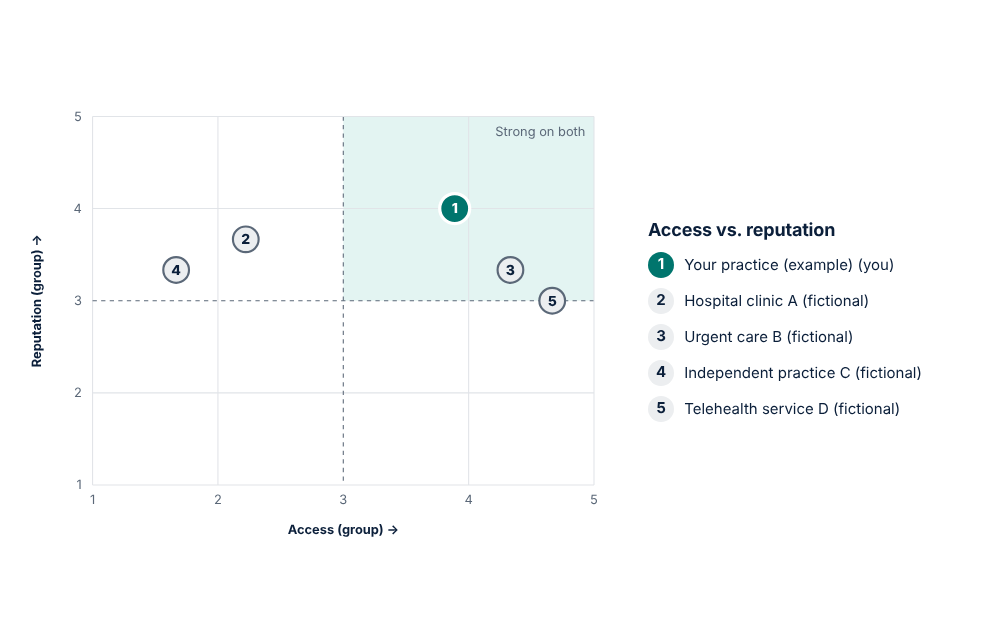
The positioning map plots any two groups or factors against each other. The tool then drafts a positioning statement ("For [patients], [practice] is the [specialty] practice that [difference], because [proof]") and a messaging comparison that shows when every clinic in town says the same thing.
Who it is for
- Owners and practice managers of independent medical, dental and allied-health practices deciding where to spend a marketing budget or preparing a partners' meeting.
- Marketing leads and agencies who need a structured brief before writing website copy.
- Clinicians opening a practice who want to know which patients are underserved before they sign a lease.
Tips for an honest competitor analysis
- Find competitors the way patients do: search for your specialty and town and see who appears first.
- Use public information only (websites, maps listings, insurer directories, published prices) and note your sources.
- Score your own practice as a new patient would see it, not as you would like it to be.
- Never contact a competitor to share or agree on prices. The FTC explains that each company must set its prices on its own, without agreeing with a competitor (FTC).
Pricing
The free tool is complete and live now.
Free
- Your practice and up to 9 competitors
- 14 weighted factors plus 10 of your own
- Positioning map, gaps, open lanes and actions
- Printable one-page brief, CSV and JSON backup
Pro
for one person, or $69 a year
- Several saved markets or locations
- Dated snapshots and a "what changed since last review" report
- Rating and review-count tracker you update over time
- Word and PDF export of the brief
Team
for a multi-location group or marketing agency: up to 5 users
- Everything in Pro for each user
- Side-by-side view of all your locations
- Shared analyses with comments
- Briefs with your own logo
Pro and Team are in early access. Reserving a spot is free and nobody is charged until their plan is activated. The prices shown are the planned launch prices, and we will email you from admin@med-rise.com before anything is billed.
Competitor analysis FAQ
How do I do a competitor analysis for a medical practice?
List the practices a new patient in your area would consider instead of you, including hospital-owned clinics, urgent care, retail clinics and telehealth services. Choose the factors patients actually compare, such as how soon they can get an appointment, hours, insurance accepted and online reviews, and decide how much each matters. Score every practice, including your own, from public information. Then look for where you clearly lead, where a competitor is clearly ahead and where nobody is strong.
How is the overall score calculated?
Each factor has a weight: nice to have (1), important (2) or critical (3). A practice's score is the weighted average of the factors you scored, rescaled so that 1 is 0, 3 is 50 and 5 is 100. Factors you left as unknown are left out rather than counted as zero, and the Known column shows how much of the weighted picture is filled in.
What is an open lane?
A factor where no direct competitor you scored is better than below average (2 of 5). If you are already strong there, it is an open lane you lead and probably your best message. If you are not, it is a chance to stand out, provided your patients care about it.
Can I use the comparison in my advertising?
The FTC allows comparative advertising that is truthful and not deceptive, so only claim what you can prove, such as your published hours. The scores in this tool are your own ratings, not proof. Your state licensing board may also have advertising rules, so check with your counsel before you publish a comparison.
Is it legal to research competitors' prices?
Collecting public information, such as published self-pay prices, is ordinary market research, and each practice is free to set its own prices. What the antitrust laws forbid is agreeing with competitors on prices or other competitive terms, so never contact a competitor to share or coordinate prices. Ask an antitrust attorney about your situation.
Where is my data stored, and can I enter patient information?
Your analysis is stored only in your browser's local storage on the device you use and is never sent to MedRise. The tool is about practices, not patients, so never enter patient names, record numbers, dates of birth or reviews that name patients. Back up saves a file you can restore later, and Clear my data deletes everything.
Sources: FTC policy on comparative advertising, 16 CFR 14.15; FTC, Price fixing.
Know what makes your practice the obvious choice
Free, private and ready in your browser. Writing the new patient handout too? Try the Patient Readability Checker.
Education and workflow support only. Practice Competitor Analysis organizes your own research and ratings; its scores are not market data, and it is not legal, marketing or business advice. Use public information only, and never contact competitors to share or agree on prices. Check advertising claims with your counsel and your state's rules. It is not for patient information. See the terms and disclaimer and privacy notice.