Patient Education Readability Checker · Free
Patient handouts your patients can actually read.
Paste a handout and see its reading grade level in seconds. Then fix it: the checker points to the medical words to swap, the sentences to shorten and the passive voice to rewrite, and shows how much each edit helped. No account, no upload. It runs in your browser.
For patient education teams, nurse educators, clinic managers and health writers. For handouts and other general materials, never patient records.
Why patient education readability matters
A handout only helps if the reader understands it. Yet, as the Center for Health Care Strategies puts it, "most health materials are written at or above the 10th grade level" (CHCS, Improving Written Communication to Promote Health Literacy). Many health literacy guides suggest a much lower target. The Penn CHIBE readability guide says to "target 6th- to 8th-grade reading level" and recommends checking with SMOG and Flesch-Kincaid (Penn CHIBE Readability Guide).
A grade level on its own does not tell you what to change, though. This health literacy readability tool shows where the difficulty comes from, so you can fix it.
How the readability checker works
1. Paste your handout
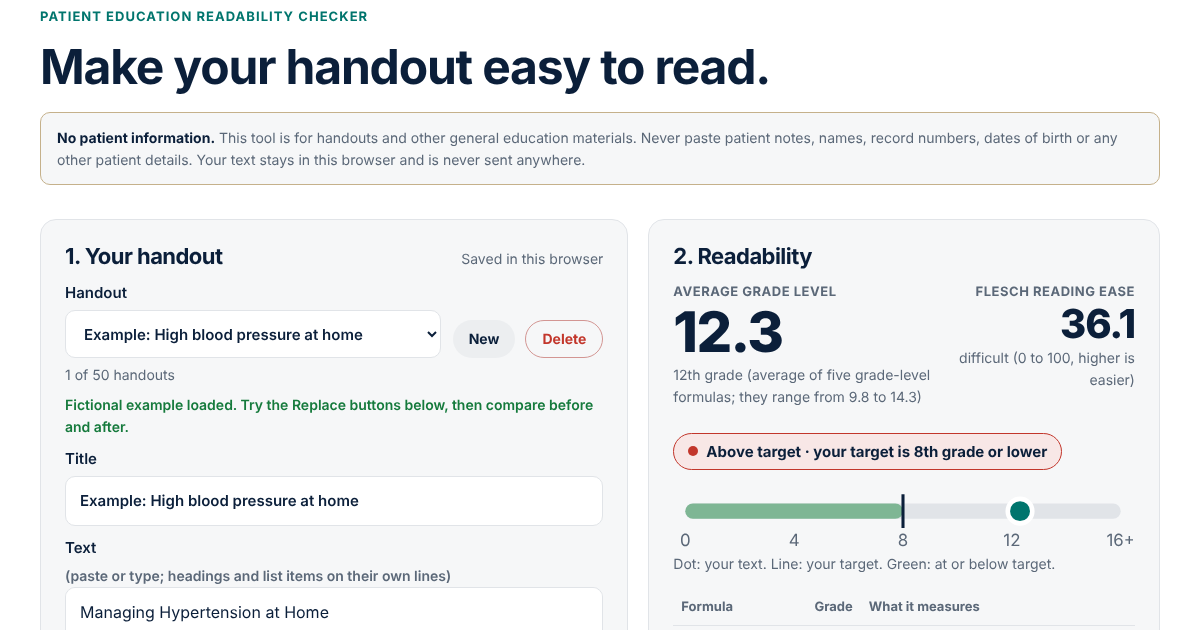
Put headings and list items on their own lines. Scores update as you type.
2. See the grade level
Five grade-level formulas plus Flesch Reading Ease, averaged and compared with your target.
3. Fix what drives it
Swap medical words for plain ones in one click, and jump to each long sentence or passive phrase.
4. Prove the change
Save a "before" snapshot, edit, and see every score move. Copy or download the report.
The formulas behind the reading grade level checker
- Flesch Reading Ease runs from 0 to 100. Higher is easier; 60 to 70 is roughly plain English.
- Flesch-Kincaid Grade Level turns words per sentence and syllables per word into a U.S. school grade.
- SMOG counts words of three or more syllables. It is a common SMOG readability calculator choice for health materials and was designed for 30-sentence samples, so the tool tells you when your text is shorter (SMOG formula).
- Gunning Fog, Coleman-Liau and the Automated Readability Index look at sentence length, "complex" words and letters per word.
The headline number is the average of the five grade levels, with the full range shown, so one formula's quirks do not decide the result.
How to lower the reading level of a patient handout
- Set your target. Pick the grade your organization uses. The tool marks anything above it.
- Swap the medical words. "Hypertension" becomes "high blood pressure", "physician" becomes "doctor". Words whose plain version depends on the sentence get a tip instead of an automatic swap. Keep any term your readers need to learn, and explain it.
- Shorten long sentences. Anything over 20 words is listed. Split it, or turn it into a numbered list of steps.
- Talk to the reader. Use "you" and say who does what: "Your nurse will check your blood pressure" instead of "Blood pressure will be checked."
- Check what formulas cannot. Work through the plain-language checklist, and for a full review use the AHRQ Patient Education Materials Assessment Tool (PEMAT). CHCS recommends testing materials with the people who will use them.
Who it is for
- Patient education and health literacy teams reviewing handouts before they go to print or the patient portal.
- Nurse educators, diabetes educators and pharmacists writing teaching sheets.
- Clinic managers and practice staff updating after-visit instructions, prep sheets and website pages.
- Health writers and researchers who need consistent scores.
Pricing
The free tool is complete and live now.
Free
- Up to 50 handouts saved in your browser
- Six readability scores and your own target
- Medical word swaps, long sentences, passive voice
- Before-and-after comparison and checklist
- Report, print, CSV and JSON backup
Pro
or $69 a year
- Account with handouts synced across devices
- Open Word (.docx) files directly
- PDF report with the highlighted text
- Your own word list and plain alternatives
- Spanish-language readability
Team
up to 10 editors; annual invoicing planned
- Everything in Pro for each editor
- Shared word list and target for your organization
- Shared handout library with review status
- Scores for every handout in one export
Pro and Team are in early access. Reserving a spot is free and nobody is charged until their plan is activated. The prices shown are the planned launch prices, and we will email you from admin@med-rise.com before anything is billed.
Patient education readability FAQ
What reading level should patient education materials be written at?
Many health literacy guides suggest a 6th to 8th grade reading level. For example, the Penn Center for Health Incentives and Behavioral Economics readability guide says to target a 6th- to 8th-grade reading level. The tool lets you set your own target from 5th to 10th grade; follow your organization's standard if it has one.
Which readability formulas does the tool use?
It shows the Flesch Reading Ease score and five grade-level formulas: Flesch-Kincaid Grade Level, SMOG, Gunning Fog, Coleman-Liau and the Automated Readability Index. The headline number is the average of the five grade levels, so no single formula decides the result.
Why does my score differ from another readability checker?
Checkers count syllables and sentences in slightly different ways. This tool estimates syllables with English spelling rules and counts each heading and list item as its own sentence. Scores from different tools can differ by a grade or more, so compare versions of a handout with the same tool.
Is a low grade level enough to make a handout easy to use?
No. Formulas only measure word and sentence length. The Center for Health Care Strategies notes that readability tools cannot judge design, imagery or cultural appropriateness. Use the checklist in the tool, consider the AHRQ PEMAT, and test the handout with people from your audience.
Can I check discharge handouts or patient notes?
General discharge handouts and teaching sheets, yes: that is what the tool is for. Patient notes or paperwork about a specific patient, no. Never paste patient names, record numbers, dates of birth or other patient details. If the text looks like it contains patient identifiers, the tool warns you and does not save it.
Where is my text stored?
Only in your browser's local storage on the device you use. Nothing is sent to MedRise. Use Back up to save a file you can open on another device, and Clear my data to delete everything.
Does it work for languages other than English?
Not yet. The formulas and the word list are for English. Spanish-language readability is planned for Pro.
Check your next handout
Free, private and ready in your browser. Load the fictional example to see every check.
Writing support only. The Patient Education Readability Checker estimates how hard text is to read. It does not check that health information is accurate or current, is not medical advice, and does not replace review by a clinician or testing with your audience. It is not for patient information. See the terms and disclaimer and privacy notice.