Patient Cycle Time Study · Free
Find out where your clinic visits wait, in one clinic day.
Time each step of the visit on a tablet or from paper sheets. See your patient cycle time, how much is waiting and which step holds patients up, then print a process document your team can act on.
For practice managers, clinic operations and QI teams. No account, nothing uploaded, no patient information.
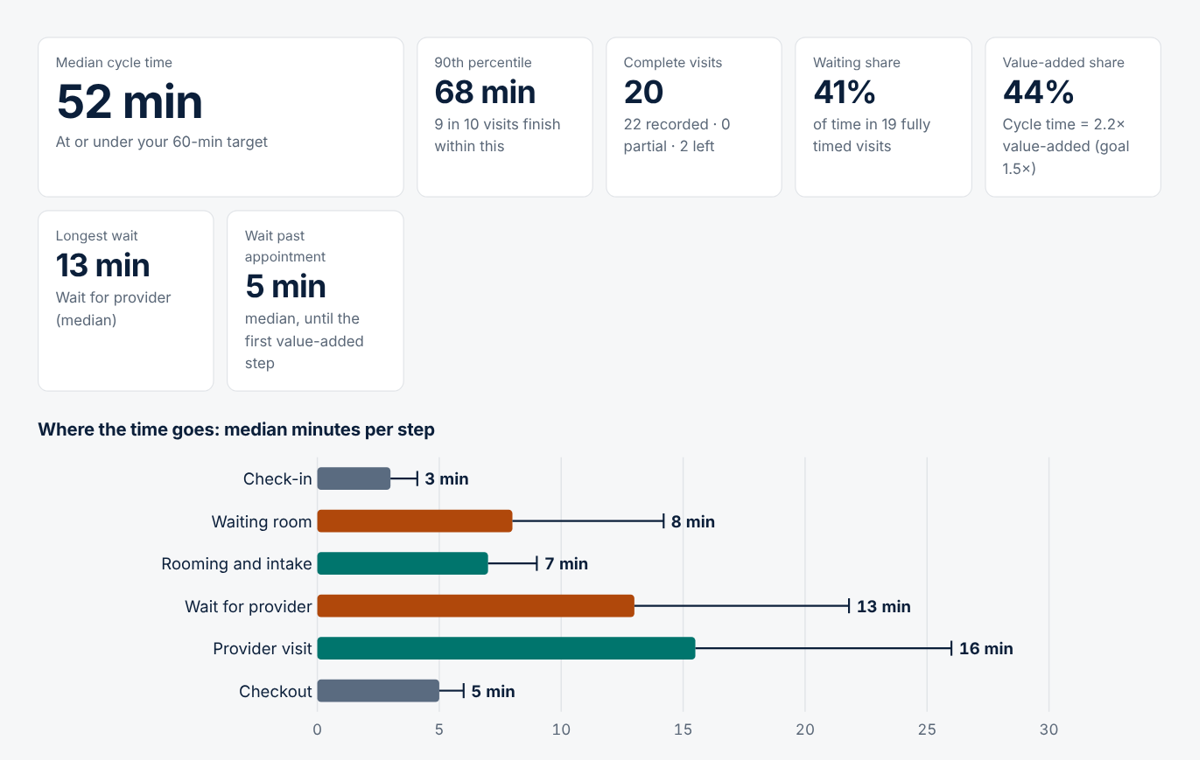
"The wait is too long." How long, and where?
Patient cycle time is the minutes a patient spends in the practice for one visit, from arrival to departure. An AAFP Family Practice Management article on patient flow recommends a few time stamps per visit that separate waiting from face-to-face time, with a rule of thumb: when an average office visit regularly runs over 60 minutes, there is usually room to improve.
The AHRQ workflow toolkit describes the time and motion study as a method that "requires little or no training." The hard part comes after the clipboards come back: typing times into a spreadsheet, working out each step and turning numbers into a plan. This free clinic patient flow analysis tool does that part and ends with a written process document, not just a chart.
How it works
1. Set up your steps
Start from seven common milestones or set your own. Mark each step value-added, waiting or admin, and name the responsible role.
2. Record visits
Tap Start a visit on arrival, then one button per milestone. Or type paper sheets, or import a CSV.
3. See the results
Median and 90th percentile cycle time, waiting share, the longest wait, and breakdowns by visit type and team.
4. Write it down
A current-state process document with scope, RACI matrix, process flow with times, exceptions, metrics and next steps. Print it or download Markdown.
Method notes
- Cycle time = last milestone minus first, for visits with both recorded. Visits that left before being seen count as exceptions.
- Step times run between consecutive milestones and count only when both times are recorded; a blank optional milestone passes its time to the next step.
- Waiting and value-added share use fully timed visits. TransforMED cites national benchmarks (IHI) of 30 minutes or 1.5 times the actual touch time.
- Wait past appointment runs from the later of arrival and appointment time to the first value-added step.
Who it is for
- Practice and office managers who want numbers before changing staffing or scheduling.
- Operations and quality improvement teams who need a baseline and a re-measure for a PDSA cycle.
- Residents and faculty doing a clinic flow project for a QI requirement.
How to run a patient cycle time study in a week
- Agree the milestones in a short huddle and decide who records them: the front desk, an observer, or the patient on a clipboard, as in the Nova Scotia Health worksheet.
- Sample a cross-section of visit types and of mornings and afternoons (OMA), and the same slots for each provider (AAFP).
- Record one or more clinic days. Tick exceptions such as add-ons as they happen.
- Open Results and find the longest waiting step.
- Write the change you will test next on the Process document tab and print it for the huddle board.
- Repeat the study after the change and compare medians.
Pricing
The free tool is complete and live now.
Free
- Up to 12 milestones of your own
- Live tap timing or typed times
- Median, 90th percentile, waiting share and bottleneck step
- Charts by step, by visit and by time of day
- Process document with RACI and metrics
- Blank paper timing sheets; print, Markdown, CSV and JSON
Pro
or $79 per year
- Saved studies with before and after comparison
- Run chart of median cycle time across studies
- Compare visit types and providers across studies
- Excel workbook export with the charts
Team
for up to 3 sites
- Several tablets record into one shared study
- Side-by-side comparison of sites
- Shared process documents with sign-off
Pro and Team are in early access. Reserving a spot is free and nobody is charged until their plan is activated; we will email you from admin@med-rise.com with the final price before anything is billed.
FAQ
What is patient cycle time?
Patient cycle time is the number of minutes a patient spends at the practice for one visit, from arrival to departure. A cycle time study breaks that total into steps, such as check-in, the waiting room, rooming, waiting for the provider, the provider visit and checkout, so you can see where the time goes.
What is a good patient cycle time?
There is no single ideal number: an AAFP Family Practice Management article says there is no such thing as ideal cycle time, and quotes a rule of thumb that an average office visit regularly over 60 minutes has room to improve. TransforMED cites national benchmarks (IHI) of 30 minutes, or 1.5 times the actual touch time. The tool starts with a 60-minute target that you can change.
How many visits should we time?
The published guides do not set a fixed number. They suggest sampling a cross-section of visit types and times of day, for example the same appointment slots once a week for each provider, and repeating the study after each change. The tool labels results with fewer than 10 complete visits as an early look and always shows how many visits each number is based on.
What counts as value-added time?
In a cycle time study, value-added time is usually the face-to-face care the patient came for, such as time with the provider and clinical intake. Waiting is time the patient is not being served, and necessary admin covers steps like check-in and checkout. You choose the type for every step, and the tool reports the share of visit time in each.
Do we need patient information to run the study?
No. Visits are numbered automatically, and the only details recorded are clock times, a visit type, an optional provider or team label and exception tags. Never enter names, birth dates, record numbers or room numbers. The study is saved only in your browser, with CSV and JSON downloads and a Clear my data button.
Sources: Backer, Family Practice Management 2002;9(6):45-50; AHRQ, Time and Motion Study; TransforMED, Reducing Patient Cycle Time (2008); Nova Scotia Health worksheet; OMA, Steps to Enhance Practice Efficiency, Part 1: Measuring Patient Flow.
Measure your next clinic day
Free and private. Try the fictional example first.
Education and workflow support only. The Patient Cycle Time Study helps a clinic measure and document how long the steps of a visit take. It does not assess, diagnose or treat anyone, is not a patient tracking or medical record system, and its results are estimates from your own sample. Never enter patient information. See the terms and disclaimer and privacy notice.