Clinical FMEA Worksheet · Free
A healthcare FMEA template that does the math.
Map a care process, list how each step could fail, and score every failure mode with the IHI risk priority number or the VA hazard scoring matrix. The worksheet ranks them, runs the decision tree, and keeps an action register with owners, dates and re-scores. No account, no upload: it runs in your browser.
For quality and patient safety teams, nurse leaders, and residents doing QI projects. Analyzes processes only, never patients.
Why FMEA spreadsheets stall
A proactive risk assessment is supposed to find failures before they reach a patient. In practice, the team meets, fills a spreadsheet with dozens of failure modes, argues about scores, and then the file sits on a shared drive. The math is easy to break, nobody can see which items cross the line, and actions lose their owners.
A Joint Commission standards FAQ (last updated in 2021) quotes the hospital requirement that "At least every 18 months, the hospital selects one high-risk process and conducts a proactive risk assessment," and lists FMEA among the acceptable approaches (Joint Commission: Risk Assessments, definition and requirement). The Joint Commission reorganized its manuals for 2026 (Accreditation 360 FAQs), so check the current manual for your program. Whatever drives your analysis, the value is in the actions you finish. This worksheet keeps the analysis and the follow-through in one place.
How the FMEA worksheet works
1. Map the process
List the steps in order, the way the work is really done, and reorder or rename them as the team learns.
2. List failure modes
For each step: what could go wrong, why, what would happen, and what already prevents or catches it.
3. Score and decide
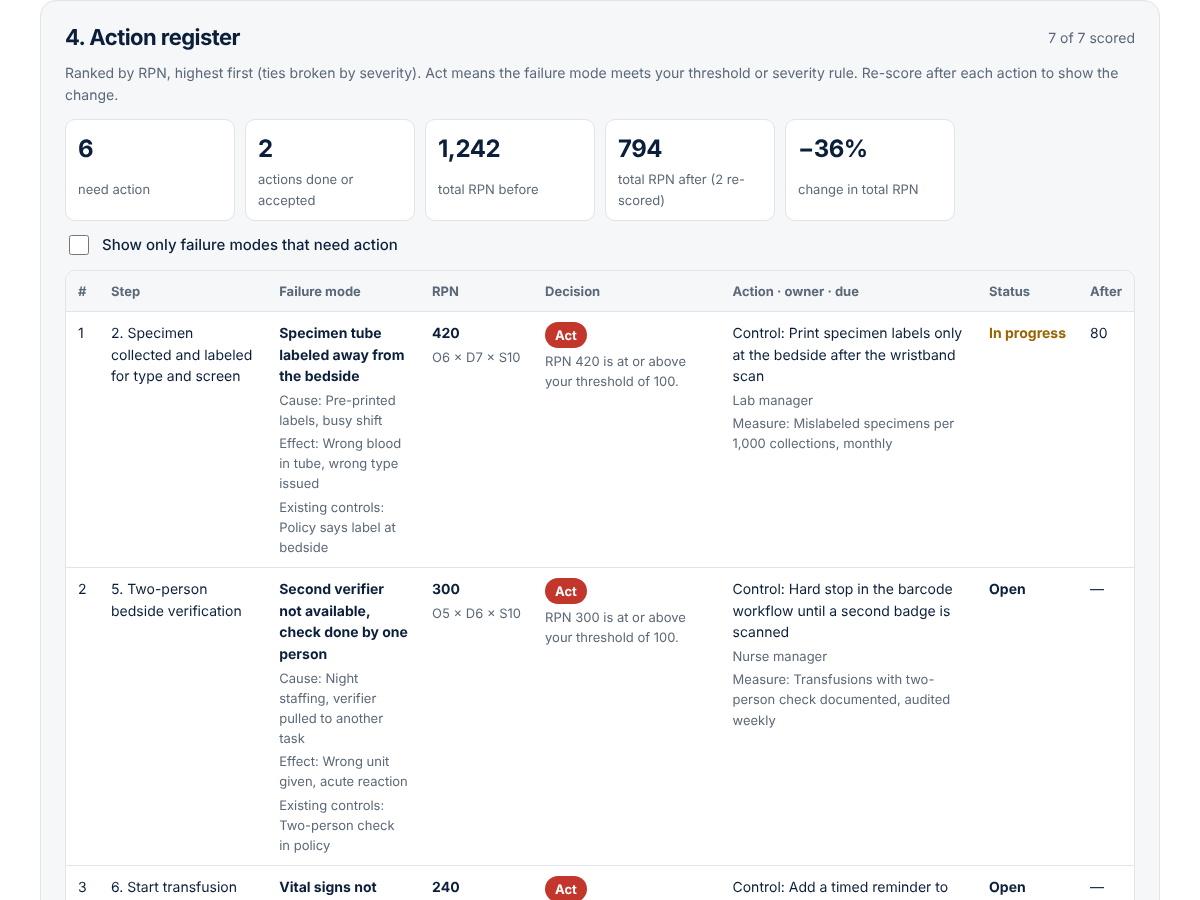
Pick a scoring method. The tool calculates the RPN or hazard score, applies your rules or the decision tree, and ranks everything.
4. Act and re-score
Give each action an owner, a target date and an outcome measure, then re-score it to show the change in risk.
Two published scoring methods, one worksheet
Risk priority number (RPN)
The IHI QI Essentials Toolkit asks the team to score each failure mode from 1 to 10 for likelihood of occurrence, likelihood of detection and severity, and to "multiply together the three scores." On the detection scale, 10 means the failure is most likely not to be detected. The lowest possible RPN is 1 and the highest is 1,000 (IHI QI Essentials Toolkit: FMEA, PDF copy hosted by UNC; the toolkit is also available from IHI). Set your own action threshold and an optional severity rule; the register shows which failure modes need action.
Hazard score and decision tree
The VA National Center for Patient Safety method scores severity (minor, moderate, major, catastrophic) and probability (remote, uncommon, occasional, frequent) from 1 to 4. The hazard score is their product, from 1 to 16, and a decision tree then decides whether to act (VA NCPS guidebook, January 2021). The guidebook sends failure modes scoring 8 or higher past the single point weakness question; those scoring 7 or lower stop unless they are a single point weakness. Then the team stops if an effective control exists or if the failure is readily detected, and documents why; otherwise it proceeds to plan an action. The tool asks those questions in order, adds a rationale field for every Stop, and shows a 4 × 4 matrix of where your failure modes sit.
You can switch methods at any time. Scores for both are kept, so a team can compare them on the same process.
How to run a healthcare FMEA with it, step by step
- Pick one high-risk process and write its scope: where it starts and ends, and which units are in.
- Bring a multidisciplinary team that includes the people who do the work. Record their roles, not patient details.
- Walk the process and enter the steps. Load the fictional transfusion example first if you want to see a finished analysis.
- Brainstorm failure modes for each step, with causes, effects and existing controls.
- Score as a team. The live score updates as you choose. Agree on your threshold before you look at the ranking.
- Plan actions for the items marked Act or Proceed: eliminate, control or accept, with an owner, a target date and an outcome measure.
- Re-score after each action and print the register or export the CSV for your quality committee.
Who it is for
- Quality and patient safety departments running a proactive risk assessment on a high-risk process.
- Nurse managers, educators and pharmacists preparing a unit-level process change.
- Residents, fellows and students doing a QI or patient safety project, and the faculty who teach FMEA.
- Clinic and ambulatory leaders who need a free FMEA template without buying risk management software.
Pricing
The free worksheet is complete and live now.
Free
- Up to 50 analyses, 80 steps and 400 failure modes each
- RPN and hazard scoring, decision tree, risk matrix
- Action register with owners, dates, status and re-scores
- CSV export, print, copy summary and JSON backup
Pro
or $79 a year, for one person
- Excel (.xlsx) and PDF report export with a team sign-off page
- Process flowchart drawn from your steps
- Starter failure-mode prompts for common processes
- Optional sync across your devices (off unless you turn it on)
Team
for a quality department or program, up to 10 members; annual invoicing available
- Everything in Pro for each member
- Shared analyses the whole team can edit
- Comments on each failure mode
- One list of open actions across all analyses
Pro and Team are in early access. Reserving a spot is free and nobody is charged until their plan is activated. The prices shown are the planned launch prices, and we will email you from admin@med-rise.com before anything is billed.
Healthcare FMEA FAQ
What is FMEA in healthcare?
Failure mode and effects analysis is a structured way for a team to look at a process before something goes wrong: list its steps, ask how each step could fail, why, and what would happen, then score and prioritize those failure modes and decide what to change. In healthcare it is used for processes such as medication administration, transfusion, specimen labeling and handoffs.
How is the risk priority number calculated?
In the IHI FMEA approach, the team scores each failure mode from 1 to 10 for likelihood of occurrence, likelihood of detection (10 means it is most likely not to be detected) and severity, then multiplies the three. The RPN runs from 1 to 1,000. The tool does the multiplication, ranks the failure modes and adds up the total before and after your actions.
What RPN should we act on?
There is no universal cut-off. Set a threshold your team agrees on, add a severity rule if you want any high-severity failure mode reviewed regardless of its RPN, and use the ranking to decide where to start. Both settings are yours to change in the tool.
What is the hazard scoring matrix and decision tree?
The VA National Center for Patient Safety method scores severity and probability from 1 to 4 each; the hazard score is their product, from 1 to 16. In the VA's 2021 guidebook, failure modes scoring 8 or higher skip the single point weakness question, and those scoring 7 or lower stop unless they are a single point weakness. Then the team stops if an effective control exists or if the failure is so obvious and readily detected that a control is not warranted, and otherwise proceeds to plan an action. The tool walks you through those questions and records the answer and your rationale.
Does The Joint Commission require an FMEA?
A Joint Commission standards FAQ, last updated in 2021, says a proactive risk assessment is required when an element of performance calls for one. It quotes the hospital requirement to select at least one high-risk process every 18 months and conduct a proactive risk assessment, and names FMEA as one acceptable approach among others. The Joint Commission reorganized its manuals for 2026, so check the current manual for your own program. This tool helps you do the analysis; it does not certify that you meet any requirement.
Can I enter patient information?
No. An FMEA analyzes a process, not a patient. The tool asks for steps, failure modes, causes, effects and actions, and it tries to catch common identifiers, such as a record number or date of birth with its value, a Social Security number, a personal email address, or a patient tied to a room or bed number, and refuses that text. The check cannot catch everything, so keep patient details out. Use roles such as charge nurse instead of names of patients.
Where is my data stored?
Only in your browser's local storage on the device you use. Nothing is sent to MedRise. Back up saves a file you can restore on another device, Export CSV opens in Excel or Google Sheets, and Clear my data deletes everything.
Can residents use it for a QI or patient safety project?
Yes. It works for a resident or student quality improvement project, a nursing unit project, or a hospital-wide proactive risk assessment. The fictional transfusion example shows a complete analysis you can learn from before you start your own.
Start your FMEA before the next meeting
Free, private and ready in your browser. Load the fictional example to see a finished analysis in one click.
Education and workflow support only. The Clinical FMEA Worksheet helps a team organize its own proactive risk assessment of a process. Scores and decisions are the team's judgments. It does not assess individual patients, does not guarantee that an analysis meets any accreditation requirement, and is not affiliated with or endorsed by IHI, the VA or The Joint Commission. It is not for patient information. See the terms and disclaimer and privacy notice.